Last Updated on September 16, 2026 by Candi Randolph
I was standing in a dressing room a few weeks ago, rolling the sleeves of a blazer for the third time that afternoon, when it hit me how automatic the whole routine has become. Roll the sleeves. Check the hem. Mentally calculate how much a tailor is going to charge me for this one. I’ve been doing some version of this since I was in my twenties, and somewhere around sixty, I finally stopped assuming it was just me being difficult to fit. It’s not me. It’s the clothes. Most of them were never built for someone my height to begin with.
At five foot three (and about 1/4 inch more when I stand up really straight), with arms and legs on the shorter side even for petite, I’ve spent decades in a strange sort of shopping limbo, standard sizes that pool at my ankles, sleeves that swallow my hands, proportions that were clearly designed with several extra inches in mind. And for a long time, I treated that as a personal problem to manage quietly, an alteration here, a rolled cuff there, never quite talking about it out loud.
Here’s what I wish someone had told me decades ago: being petite was never something to work around or apologize for. It’s simply a proportion, one that responds beautifully to the right information, and terribly to the generic advice most fashion content hands out without ever considering that not everyone is five foot seven. So that’s what I want to hand you instead, the petite fashion after 60 specifics nobody bothered to mention, the kind that actually make a difference when you’re getting dressed at this height, at this age.
If you’ve ever stood in a dressing room doing the same sleeve-rolling calculation I have, I promise, there’s an easier way through this. Let’s get into it.
If you click on a link and then make a purchase, I may earn a small commission at no additional cost to you. Thank you!
Petite Isn’t a Flaw to Work Around
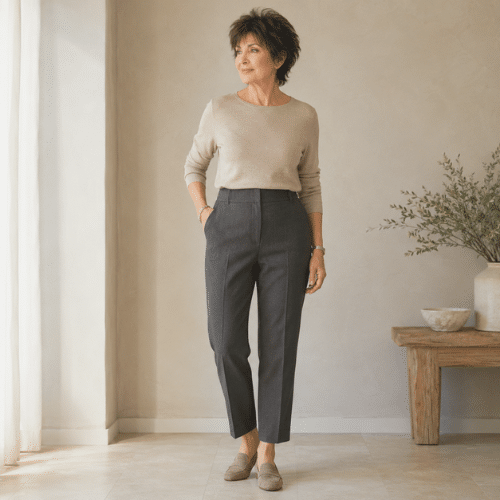
I want to start by naming something that took me far too long to notice: nearly every piece of style advice aimed at petite women is written in the language of correction. Elongate. Minimize. Create the illusion of height. As if five foot three were a mistake the outfit needed to quietly apologize for. I followed that advice for years, and it never once made me feel put-together. It made me feel like I was in disguise.
Here’s the reframe I needed, and the one I hope saves you some time: petite isn’t a flaw, it’s a proportion. It’s not a smaller, incomplete version of a “normal” frame that needs fixing. It’s simply a different set of measurements, and clothes either respect those measurements or they don’t. The problem was never my height. The problem was an industry that designs for one height and calls everything else an exception.
Once I let go of the “create the illusion of height” mindset, something genuinely shifted. I stopped dressing to trick the eye and started dressing to fit the body I actually have, short arms, short legs, and all. It turns out those are just facts, not obstacles, and clothes that acknowledge them outright tend to look better than clothes trying to talk around them.
So before we get into any of the practical parts, sleeves and hems and where a jacket should end, I want that to be the foundation underneath all of it. You’re not petite despite something. You’re petite, full stop, and every tip in this post is about working with that reality instead of quietly apologizing for it.
The Proportion Rules That Actually Matter
Once you stop trying to disguise your height, the next question is simpler than you’d think: what actually changes when you’re dressing a shorter, more compact frame? A handful of things, and once you know them, you stop needing a rulebook and start just seeing them automatically.
Rise matters more than almost anything else. A high or mid-rise pant, sitting closer to your natural waist, does more for a petite frame than any amount of careful top-tucking ever will. When pants sit too low, they eat into leg length you don’t have extra of to spare. It’s a small shift, an inch or two in where a waistband lands, but it changes the whole line of an outfit.
Hem length is the other big one, and it’s worth actually measuring rather than guessing. A pant that pools even slightly at the ankle reads as “borrowed from someone taller,” while one that hits right at or just above the ankle bone reads as intentional. Same logic applies to skirts and dresses, a hem that hits mid-calf on someone five foot seven often lands at a much less flattering spot on someone five foot three. It’s not about a universal “best length.” It’s about knowing your own proportions well enough to recognize when something’s off.
Jacket and cardigan length deserves its own mention too, since so many of us default to whatever’s on the rack. A blazer that ends right at the hip bone, rather than several inches past it, keeps your leg line intact instead of visually shortening it. I learned this one the hard way after years of longline cardigans that I genuinely loved and that did absolutely nothing good for my proportions.
And then there’s the quieter tool: vertical lines. A monochromatic outfit, a long open cardigan worn over similar tones, a subtle vertical seam or stripe, these all create a sense of continuous length without any illusion or trickery involved. It’s simply using the eye’s natural tendency to follow a line.
Here’s the gentle reframe: none of this is about rules you have to memorize and follow perfectly. It’s about understanding what your proportions actually respond to, so you can make quick, confident decisions instead of second-guessing every hemline.
What to Look for When You Shop
Knowing the proportion rules is one thing, spotting them on a rack or a screen in the thirty seconds before you decide to try something on is another skill entirely. Here’s what I actually look for now, before a piece even makes it into the fitting room.
Shoulder seams are the first thing I check, because they’re the hardest and most expensive thing to alter. If a shoulder seam sits even slightly past where your actual shoulder ends, the whole garment is going to hang wrong no matter what you do to the hem or the waist. A jacket or top with a shoulder seam that lands right at your shoulder bone is doing at least half the work for you before you’ve made a single other decision.
Sleeve length is the next thing I’ve trained myself to notice, especially on anything with a cuff or a defined hem, since those are the hardest to shorten well at home.
Print and pattern scale matters more for petite frames than people realize. A large, bold print that would look striking on a taller frame can visually overwhelm a smaller one, swallowing the body instead of complementing it. I’ve started looking for smaller-scale or more vertically-oriented prints, and it’s made a noticeable difference in how balanced an outfit feels.
And fabric weight deserves a mention too. Heavier, stiffer fabrics tend to add bulk that a smaller frame doesn’t have much room to absorb, while a fabric with a little more drape and movement, the kind that skims rather than stands away from the body, tends to work better across the board. Quince has become a reliable source for me here, their fabrics have that softer drape without sacrificing structure, which is exactly the combination a petite frame benefits from.
Here’s the gentle reframe: shopping for a petite frame isn’t about settling for whatever’s in your size range. It’s about learning to read a garment quickly, shoulders, sleeves, print scale, fabric weight, so you can tell within seconds whether something’s actually going to work for your proportions.
Tailoring, the Quiet Superpower
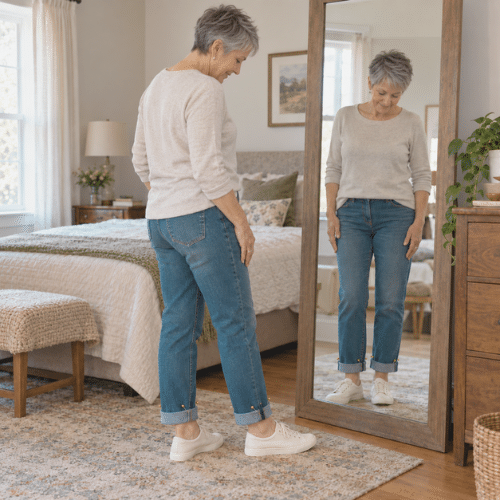
Here’s something I wish I’d embraced decades earlier instead of resigning myself to rolled cuffs and safety-pinned hems: tailoring isn’t a failure of shopping. It’s the single most powerful tool a petite frame has, and most of us underuse it out of habit, or a vague sense that altering something means we bought the wrong thing.
We didn’t buy the wrong thing. We bought a garment designed for an average that most of us don’t fit, and a good tailor is simply the bridge between that average and our actual proportions. A hem shortened by two inches, sleeves taken up an inch and a half, these are small, inexpensive adjustments that change how an entire outfit sits on your body. I can handle these simple alterations myself, but will reach out to a tailor when I’m not in ‘seamstress’ mood.
The pieces worth prioritizing for tailoring are the ones you reach for constantly, your everyday pants, a blazer you wear often, a coat you’ll have for years. These are worth the investment because you’ll wear them dozens of times, and every single wear benefits from the adjustment. A special-occasion piece you’ll wear twice matters less here, save your tailoring budget for the workhorses.
And if you’re new to this, finding a good tailor is easier than it sounds. Ask at a dry cleaner, since many either do alterations in-house or know exactly who does. A quick hem and sleeve shortening is usually a same-week turnaround, and it becomes one of those quiet habits, like the finishing touch from my last post, that pays off far more than the small effort it takes.
Here’s the gentle reframe: tailoring isn’t admitting defeat. It’s the difference between clothes that technically fit and clothes that actually fit you, and once you build that habit, you’ll wonder why you spent so many years just rolling the sleeves instead.
Closing Thoughts – Petite Fashion After 60
I still think about that dressing room moment sometimes, rolling those sleeves for the third time, doing the mental math on tailoring costs before I’d even decided if I liked the blazer. What’s changed since then isn’t the height, obviously, that’s staying exactly where it’s been my whole life. What’s changed is how I think about it.
Five foot three, short arms, short legs, these were never problems to solve. They were just facts, the same as anyone’s proportions are just facts, and once I stopped trying to dress around them or apologize for them, getting dressed got a lot simpler. Rise that sits where it should. Hems that hit the right spot. A tailor who knows my name. A few smaller-scale prints and softer fabrics that actually move the way I need them to. None of it dramatic, all of it adding up.
If you’ve spent years quietly managing a frame the fashion world mostly forgot to design for, I hope this gave you something more useful than “create the illusion of height” ever did. You don’t need an illusion. You need clothes that were made with your actual proportions in mind, and now you know exactly what to look for. That dressing room doesn’t have to feel like a negotiation anymore. It can just feel like getting dressed.