
Last Updated on October 27, 2026 by Candi Randolph
Somewhere on your bathroom counter is probably a jar you bought with real hope and used for about two weeks. Most of us have a few, and there’s no shame in them. They’re what happens when the shelf gets louder than the routine.
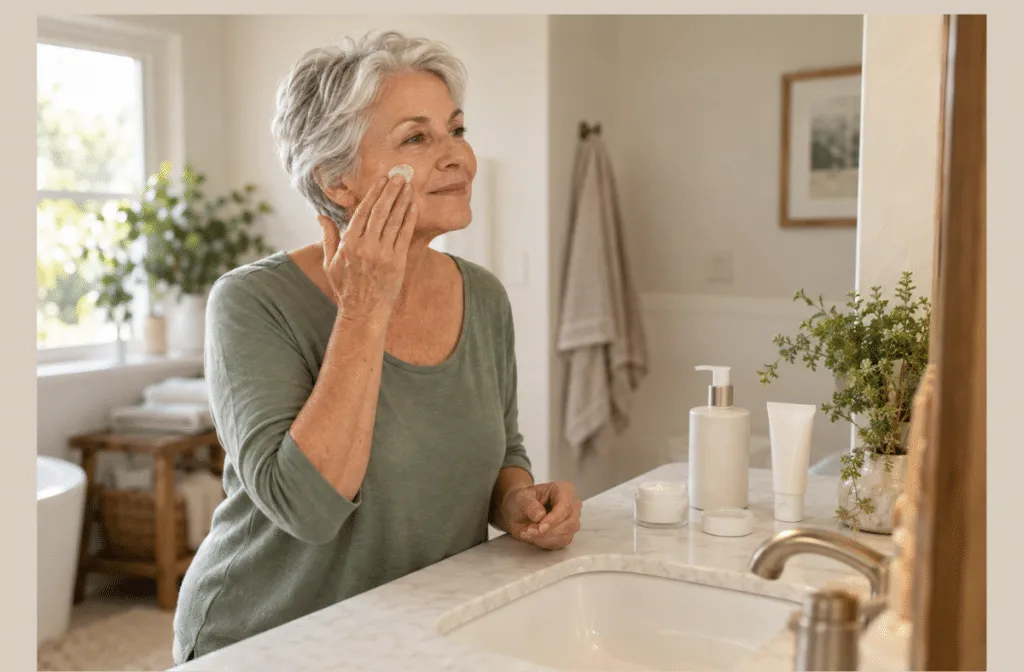
Skincare for aging skin comes down to five things: a gentle cleanser, moisturizer, and broad-spectrum sunscreen every day, plus vitamin C in the morning and a low-strength retinoid at night once your skin welcomes it. I’d go further and say that a routine you’re still doing twelve weeks from now will do more for your face than the most impressive jar you could buy today. It’s not about finding the perfect product. It’s about finding the ones you’ll actually use, so gentle, affordable, and a little boring wins.
A quick note before we start: I’m not a dermatologist, just a woman who’s tried a lot of products and done a lot of reading along the way. What follows is general advice, not personalized medical advice. If you have a skin condition, use prescription skin medication, or notice a spot that’s changing, please check with your own doctor or dermatologist.
If you click on a link and then make a purchase, I may earn a small commission at no additional cost to you. Thank you!
Table of Contents
- What a Routine for Aging Skin Is Really For
- Why Two Ingredients Separate a Basic Routine From a Full One
- The Daily Routine, Morning and Night
- Habits From Your Thirties That Work Against You Now
- When to Add, Swap, or Hold Steady
- Frequently Asked Questions
What a Routine for Aging Skin Is Really For

A routine for aging skin is a small set of daily steps meant to keep your skin comfortable, protected, and looking its healthiest, rather than to erase the years. It’s for women who’ve noticed their skin behaving differently than it did a decade ago and want a plan instead of a pile of samples.
It differs from the wider beauty market in one important way: a market runs on newness, while a routine runs on repetition. It also differs from treatments in a dermatologist’s office, which happen now and then, while what you do at your bathroom sink happens twice a day for years. I’ve written before about natural aging and skin care after 50, and that frame matters here, because the goal is skin that feels good on the face you have today, not skin pretending to be 35.
Why Two Ingredients Separate a Basic Routine From a Full One
Strip away the packaging and two well-known routines look almost identical. Harvard Health Publishing advises keeping it simple and focusing on three steps: wash, moisturize, and apply sunscreen, every day. Cleveland Clinic says a simple routine should include five ingredients: a gentle cleanser, vitamin C, retinol, moisturizer, and broad-spectrum sunscreen.
Lay those side by side and the whole gap is two ingredients. That’s it.
Everything else on the drugstore wall is a variation on those five jobs, dressed up with a new texture, a new scent, or a new word on the label. That’s how the shelf got so crowded while the routine underneath barely moved. When I look at a “new” product now, my first question is which of the five jobs it does, and whether I already own something that does it.
The three foundation steps are low drama. Most people tolerate a mild cleanser, a plain moisturizer, and a sunscreen they like the feel of, and the main work is finding versions you enjoy enough to use every single day.
The two extra steps are where the real choices live, and where your own skin casts the deciding vote. Retinoids come in more than one form and strength. Harvard Health notes that adapalene, a retinoid, is also available over the counter in a 0.1% formulation, versus the 0.3% prescription version. Vitamin C has a reassuring track record on the comfort side: the Linus Pauling Institute reports that human studies using topical solutions of 0.6% to 10.0% vitamin C or its synthetic derivatives have not reported adverse effects.
So the decision in front of you is about tolerance, not about finding a secret formula. A retinoid your skin resents will end up in a drawer, and a drawer does nothing for your face. If retinol and your skin simply don’t get along, I’ve covered anti-aging options beyond retinol that still earn a place in a simple routine.
The Daily Routine, Morning and Night

Here’s the order I’d follow, one small step at a time.
- Wash your face morning and evening with a gentle cleanser and lukewarm water. If your skin feels tight or squeaky afterward, that cleanser may be too strong for the skin you have now.
- Smooth on a vitamin C serum after cleansing in the morning. The Linus Pauling Institute notes that topical vitamin C at 3% to 10%, used for at least 12 weeks, has been shown to decrease wrinkling, reduce protein fiber damage, decrease the apparent roughness of skin, and increase collagen production. The Institute also points out that the effects aren’t apparent in everyone and that research is limited, so think of it as a gentle bonus and not a promise. Cleveland Clinic suggests giving any new product about three months, so give your serum the full stretch before you decide anything about it.
- Follow with moisturizer while your skin is still slightly damp, and don’t forget your neck.
- Finish every morning with broad-spectrum sunscreen, on gray days and stay-home days too. Pick one whose texture you like, because the sunscreen you enjoy wearing is the one you’ll reach for.
- Add a retinoid at night, in the evening only. Harvard Health notes that retinoids make skin sensitive to light, so they don’t belong in your daytime routine. Start slowly, every third night or every other night. Consumer Reports notes that over-the-counter formulas may range from about 0.01 to 2 percent retinol, and that beginners typically start at lower strengths and increase gradually as their skin builds tolerance. Choose from the lower end, apply it to dry skin, and moisturize after.
- Keep every product the same for twelve weeks, and support your skin from the plate as well. The anti-aging superfoods I’ve written about here make an easy companion to anything you put on your face.
If your budget only stretches to three products, buy the cleanser, moisturizer, and sunscreen first. Those are the steps both routines above agree on, and the other two can wait until you know your skin is happy with the basics.
Habits From Your Thirties That Work Against You Now
That foaming cleanser you’ve loved for twenty years may be the first thing to go. The routine that worked at 35 assumed skin that could shrug off harsh washing and gritty scrubs, and that assumption often stops holding as we get older. I walked through how our skin changes with age in an earlier piece, and it’s worth a read before you buy anything new. Swap stripping products for gentle ones before you add a single active.
Reaching for the strongest retinol on the shelf feels efficient. It often backfires. Harvard Health cautions that these products can irritate the skin if overused, and if your first bottle leaves you red and flaky, you’ll stop using it, and a retinoid you abandon after two weeks gives you nothing. Start low, build slowly, and let your skin tell you when it’s ready for more.
Three new products in one week is a recipe for confusion. If something stings or breaks you out, you have no way of knowing which one did it, so you end up tossing all three, including the one that was doing you good. Introduce one product at a time and give it a couple of weeks on its own before adding the next.
Natural remedies tend to get treated as either a full replacement or a joke, and neither view serves you well. I’ve shared natural anti-aging remedies for concerns after 60 that sit comfortably alongside a simple routine. Pick one that targets a concern you really have, rather than stacking a kitchen’s worth of masks on top of your daily steps.
Sunscreen as a beach-only product is a habit many of us grew up with. Your daily routine treats it as the last step every single morning, year-round. If yours feels greasy or leaves a cast, change the sunscreen, not the habit.
When to Add, Swap, or Hold Steady

The choice you’re facing most weeks is simple: leave the routine alone, add something, or change something.
Hold steady if you started a product less than twelve weeks ago, or if your skin feels comfortable and you simply want to see results faster. That impatience is the moment a shiny new launch looks tempting, and it’s also the moment that resets your clock to zero.
Add something when the three basics have felt good for several weeks and you want to do more. Vitamin C is a gentle first addition for many people; a retinoid can come after, at a low strength. For more ideas on what to prioritize as the decades go by, my best skin care tips for over 60 go a little further.
Swap something when your skin sends a steady signal: tightness after washing, stinging that doesn’t settle, or dryness that shows up as the weather turns. A seasonal change often calls for a richer moisturizer rather than a whole new routine, and the winter version of the routine I’ve written about shows how small that adjustment can be.
And if a spot is changing, irritation won’t calm down, or over-the-counter options aren’t giving you what you hoped for, book time with a dermatologist. Stronger prescription retinoids exist for a reason, and they fit inside the same simple structure. If you’d like company along the way, the Natural Aging section here at Inspire My Style is a good place to keep reading, and I hope you leave this page feeling that a calm, small routine is not a lesser one.
Frequently Asked Questions
What is the most effective skincare routine for aging skin?
The routine that works best is the short one you’ll follow every day. Wash with a gentle cleanser, apply vitamin C in the morning, moisturize, and finish with broad-spectrum sunscreen. At night, add a low-strength retinoid a few evenings a week once your skin is comfortable. If you’re just starting, the three basics alone (cleanser, moisturizer, sunscreen) are a complete routine. Add the two actives one at a time, give each one about twelve weeks, and let your skin’s comfort decide whether you move up in strength.
Should I start with vitamin C or retinol?
For many women, vitamin C is the easier first step. It goes on in the morning under moisturizer and sunscreen, and studies of topical vitamin C have not reported adverse effects. Retinol asks more of your skin’s tolerance, so it makes sense to add it later, at the lower end of the over-the-counter range, starting with a few nights a week. Keep them in separate parts of the day so you can tell how your skin responds to each one, and introduce them weeks apart.
How long should I use a new anti-aging product before deciding it doesn’t work?
Give it about three months unless it irritates you. Cleveland Clinic suggests about three months for new skin care products, and Harvard Health notes that visible wrinkle improvement from retinoids can take three to six months of regular use. Switching products every few weeks means you never reach the point where you could judge them fairly. The exception is discomfort: persistent stinging, redness, or flaking means the product or strength isn’t right for your skin now, and you should stop or scale back rather than push through.
Sources
- Solan, M. (2023, May 1). Winning the skin game. Harvard Health Publishing.
- Best Ingredients and Products for Your Anti-Aging Skin Care Routine. Cleveland Clinic (2023).
- Do retinoids really reduce wrinkles? Harvard Health Publishing (updated January 13, 2025).
- Michels, A. J. Vitamin C and Skin Health. Linus Pauling Institute, Oregon State University.
- Campbell, D. (2026, August 14). The Most Effective Anti-Aging Skin Care, Explained. Consumer Reports.
